

Obedience After Autonomy II
Language After Legitimacy

Arc I: The Collapse Of Legitimacy, 2(2)/8
Autonomy promised emancipation from authority. It delivered a culture of compulsive speech. We were told that nobody gets to govern the self from outside, then we discovered that the self can be governed from within by the most fragile instrument of all, which is the words it is permitted to use, and the words it is required to repeat.
When legitimacy is stable, language can afford to be relaxed. People can disagree without feeling that the ground is dissolving beneath them. Words have ordinary weight. They can fail, be corrected, be refined, then returned to service.
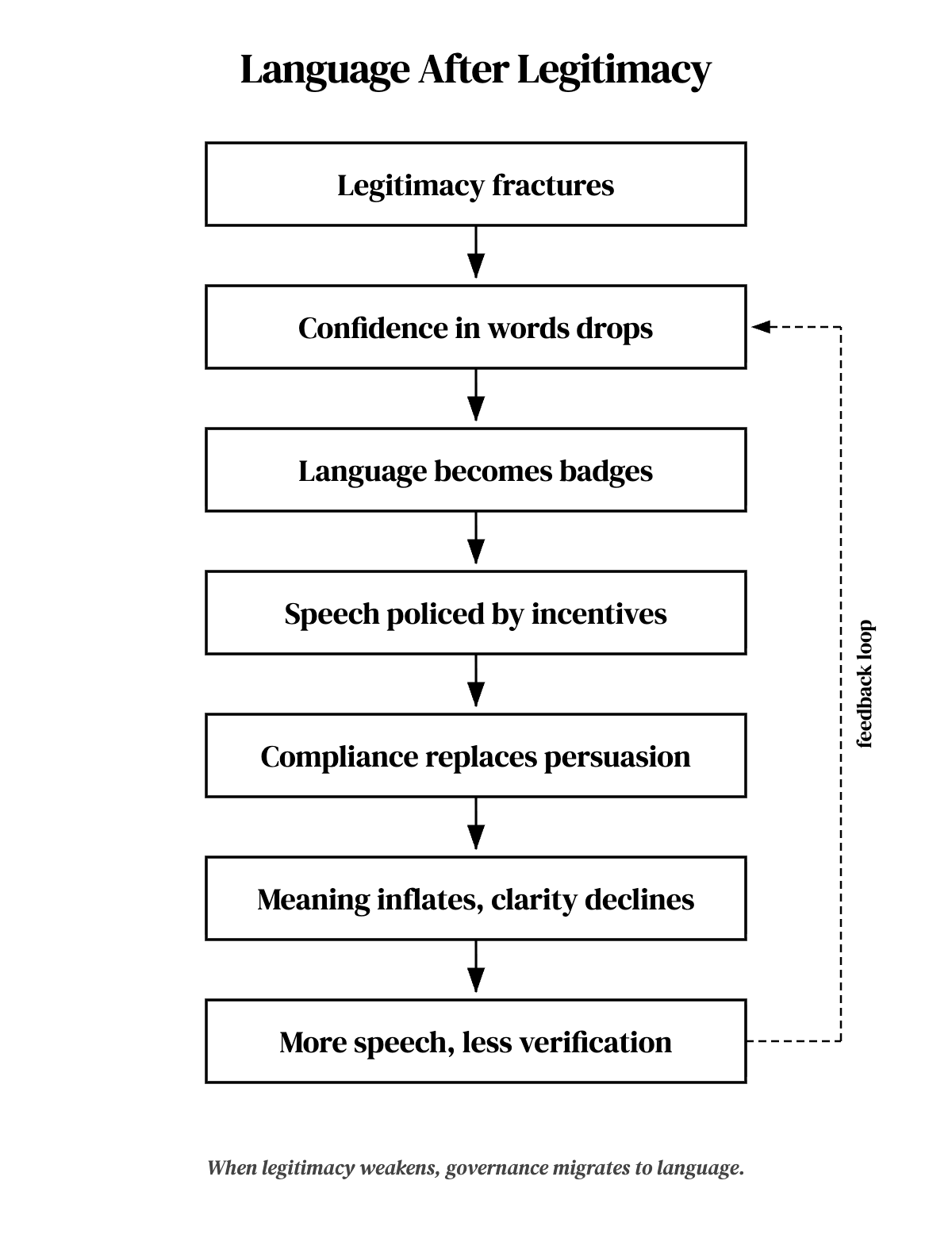
When legitimacy collapses, language becomes nervous. Words begin to function as badges. The sentence becomes a uniform. Speech is treated less as a vehicle of truth and more as a test of belonging. The culture that advertised itself as liberated becomes intensely supervised, not always by law, but by reputational pressure, career incentives, platform rules, and the ambient fear of being assigned a moral diagnosis.
This is obedience after autonomy. It is obedience through language.
I. The New Obedience Is Verbal
The modern subject still obeys. He obeys what he must say in order to keep access to institutions. He obeys what he must not say in order to keep social standing. He obeys the ritual phrases that signal the correct posture, and he learns to speak in ways that prevent questions from forming.
The obvious paradox is that the culture that distrusts authority is the culture that cannot stop issuing verbal permissions and verbal prohibitions. A society that claims to be suspicious of moralism becomes a society that moralizes sentences.
None of this requires a conspiracy. It follows from a basic fact. If people cannot agree on the legitimacy of authorities, they will shift the struggle onto the nearest surface where authority can still be exercised. Language is that surface.
II. Adults Live By Mediation
Lonergan’s point is not difficult, which is why it is often ignored. Adults do not live in the infant’s immediacy. They live in a world constituted by meanings carried in language, memory, testimony, symbol, institution. Lonergan calls this the “world mediated by meaning.”
This matters because the world mediated by meaning is not optional. One can rebel against a priest, a professor, a politician, and still remain dependent on meanings one did not create. One can despise institutions and still rely on the linguistic and social inheritance those institutions transmit. Even the slogan “think for yourself” is not a private invention. It is a received phrase, and it performs a public function.
So the question cannot be whether mediation exists. The question is what happens to mediation when legitimacy fails.
III. Legitimacy Is the Credit of Words
Words operate a bit like money. They are instruments of exchange. They allow cooperation across time, across distance, across difference. But like money, they require backing. A currency without confidence does not vanish. It inflates. It becomes less capable of doing the work it was designed to do.
Lonergan uses exactly this kind of language when he describes what happens in doctrine when the words remain while the reality they intend is no longer personally appropriated. There follows an “inflation,” or “devaluation,” of this language, and so of what it is supposed to convey.
That is a theological example, but it names a general pattern. When people lose confidence that words track reality, they do not stop speaking. They speak more. They speak louder. They build larger moral and administrative systems around speech because it is the only remaining domain that can be policed at scale.
A legitimacy crisis, therefore, produces a linguistic crisis. You get more talk with less meaning, more moral heat with less intelligibility, more enforcement with less persuasion.
IV. When Words Lose Meaning, They Gain Power
A stable culture can permit ambiguity because it can assume eventual clarification. A brittle culture cannot. It treats ambiguity as threat, because ambiguity permits questions, and questions expose the absence of shared verification.
So the culture begins to demand not simply agreement, but verbal compliance.
The shift is subtle. The older liberal ideal was disagreement within a shared reality. The newer pattern is disagreement treated as evidence of moral contamination. Words are no longer primarily about reference. They become markers of interior status. One learns to speak so as to avoid being interpreted, because interpretation has become punitive.
This is why language becomes simultaneously less informative and more compulsory. The point is not communication. The point is sorting.
Once again, Lonergan helps here by clarifying that meaning is social but not therefore arbitrary. Meaning is the achievement of attentiveness, intelligence, reasonableness, and responsibility in common life. When those operations are weakened, language becomes detached from the labor that once sustained it. The culture still uses the vocabulary of truth, justice, dignity, harm, care, inclusion, tradition, freedom, and so on. But these terms drift. They acquire the texture of spells; they are potent when spoken, dangerous when questioned.
V. Peterson’s Counterproposal
Whatever one thinks of Peterson’s wider cultural role, one feature of his appeal is easy to state, that is, he treats speech as a moral act. His counsel is epistemic, and not merely therapeutic as some may think. He argues that vague speech is often a form of evasion, and that precision forces reality contact.
His Rule 10 (in Twelve Rules for Life) is blunt even in its title: “Be Precise in Your Speech.” He portrays the refusal to specify as a way of keeping a problem both present and unaccountable. Precision, by contrast, makes a problem claimable and correctable.
This is why Peterson’s advice often lands like relief. In a culture where words are used to manage impressions, he urges words that expose what is actually happening. In a culture where speech is used to purchase belonging, he urges speech that purchases clarity.
And we see in rule 8 he presses the same logic from another angle: “Tell the truth, or at least don’t lie.” Lying, in Peterson’s idiom, is not just a social sin but metaphysical vandalism. It corrupts the structure within which one must live.
If legitimacy is the credit of words, Peterson is proposing an anti-inflation policy by restoring meaning by tying language back to reality, even when the social incentives reward vagueness.
VI. Compelled Speech Is a Symptom of Illegitimacy
Peterson became a public figure partly through conflicts about compelled speech. One does not need to rehearse those controversies to draw the relevant principle that when institutions cannot secure assent through intelligibility, they will often attempt to secure conformity through language control.
Compulsion is not proof of authority. At least not a legitimate authority. It is evidence of its fragility.
A legitimate authority can usually give reasons that withstand scrutiny. It does not need to treat dissent as pathology. It does not need to recruit bureaucratic language to substitute for persuasion. When it does, the result is predictable, that is, people comply outwardly and dissent inwardly, or else they retreat into subcultures where language becomes equally rigid, simply with reversed moral signs.
Thus, the legitimacy problem recurs, now magnified. Public speech becomes scripted. Private speech becomes resentful. Neither is oriented toward the patient work of verification.
VII. The Obedience Mechanism
When a culture weakens the operations by which judgments are made, it will still require decisions. It will still require coordination. But it will lack the interior discipline that makes coordination sane.
In that vacuum, speech begins to function as a substitute for judgment. If one cannot be confident that a claim is true, one can at least be confident that a claim is socially approved. If one cannot verify, one can repeat. If one cannot persuade, one can shame.
This is why language becomes moralized. Moralization is a counterfeit of certainty. It provides the feeling of solidity without the labor of evidence and reflective testing. It also provides an instrument of punishment that can be deployed without argument.
Because we live in a world mediated by meaning, the corruption of meaning is never a small thing. It is the corruption of the medium in which common life occurs.
VIII. Retrieval Rather Than Regression
The response to linguistic obedience is often regression. People get tired of ritual phrases, then they flee into counter-rituals. They stop trusting official euphemisms, then they embrace vulgarity as honesty. They refuse one set of required words, then adopt another set with equal rigidity.
That solves nothing. It simply relocates the same problem.
A more serious response begins where Lonergan begins, that is, with the subject’s operations. If the world is mediated by meaning, then the rehabilitation of meaning requires subjects capable of sustaining it. That does not start with new vocabularies. It starts with renewed attentiveness, renewed intelligence, renewed reasonableness, renewed responsibility.
In practice, that looks less heroic than people imagine. It means defining terms before moralizing them. It means refusing to treat labels as arguments. It means asking, with Peterson’s irritating usefulness, “What do you mean by that?” It means acknowledging that speech is never merely expressive. Speech commits the speaker. It either serves truth, or it serves appetite.
Within Catholic terms, this has an obvious resonance. The Church is a community of Word and sacrament. If ecclesial language is treated as mere identity performance, it too inflates. If liturgical and doctrinal language is appropriated as a living mediation of truth, it regains weight. Lonergan’s warning about the devaluation of doctrinal language is therefore a pastoral alarm.
IX. The Only Obedience Worth Keeping
Autonomy was never a sustainable foundation because human beings are not self-originating meanings. We learn to speak before we learn to think. We learn what is good largely by receiving it, then judging it, then consenting to it. There is no human maturity without mediation.
So the real question is not whether we will obey. The question is what we will obey through our speech.
If words are detached from reality, then speech becomes an instrument of domination, even when it wears the costume of care. If words are reattached to reality, then speech becomes an instrument of communion, even when it costs.
Language after legitimacy is therefore the harder work of restoring the moral and cognitive conditions under which words can once again mean what they say.