

When Judgment Goes Wrong
Lonergan on Incorrect Judgment, Absolute Objectivity, and Why Kant Does Not Go Far Enough

We usually treat error as an embarrassment. We were mistaken. We revise the claim. We move on. But error is far stranger than that. It is one of the few humiliations that comes with a metaphysical lesson hidden inside it.
A man may be cold, proud, arrogant, or ridiculous without noticing it. A false judgment is harder to hide. It carries within itself the possibility of rebuke. Reality answers back. The world does not salute our sincerity simply because it is sincere. It does not kneel before our intensity simply because it is intense. It waits. Then, with great patience and no sentimentality whatever, it lets the crooked thought strike the straight wall.
That is where Bernard Lonergan begins to become genuinely dangerous. He refuses the easy consolations. He will not permit us to say that judgment is only expression, or only language, or only coherence within a horizon. He asks a question that is both more innocent and more terrible. Do correct judgments occur at all. In Insight he says exactly that, and he adds that the whole matter comes to a head in the concrete act of judging itself.1
That question is the doorway to his account of objectivity. It is also the point at which he parts company with Kant. For Kant had already shattered the old innocence. He had already shown that the subject cannot be ignored, that knowing is not a bare window standing open to things. Yet Lonergan thinks Kant stopped too soon. He halted at the threshold of the subject and never fully entered the interior drama by which intelligence asks, reflection weighs, and judgment assents, let alone when responsibility decides! He described the conditions under which objects appear. Lonergan wanted to know how a reasonable yes or no becomes possible at all.2
That difference changes everything.
Being Wrong Is a Revelation
The modern temptation is to treat error as if it were merely a practical inconvenience. We revise the model, look for new data, adjust the language, update the framework. Lonergan sees something deeper. Error reveals the structure of knowing because judgment is the place where the mind risks itself.
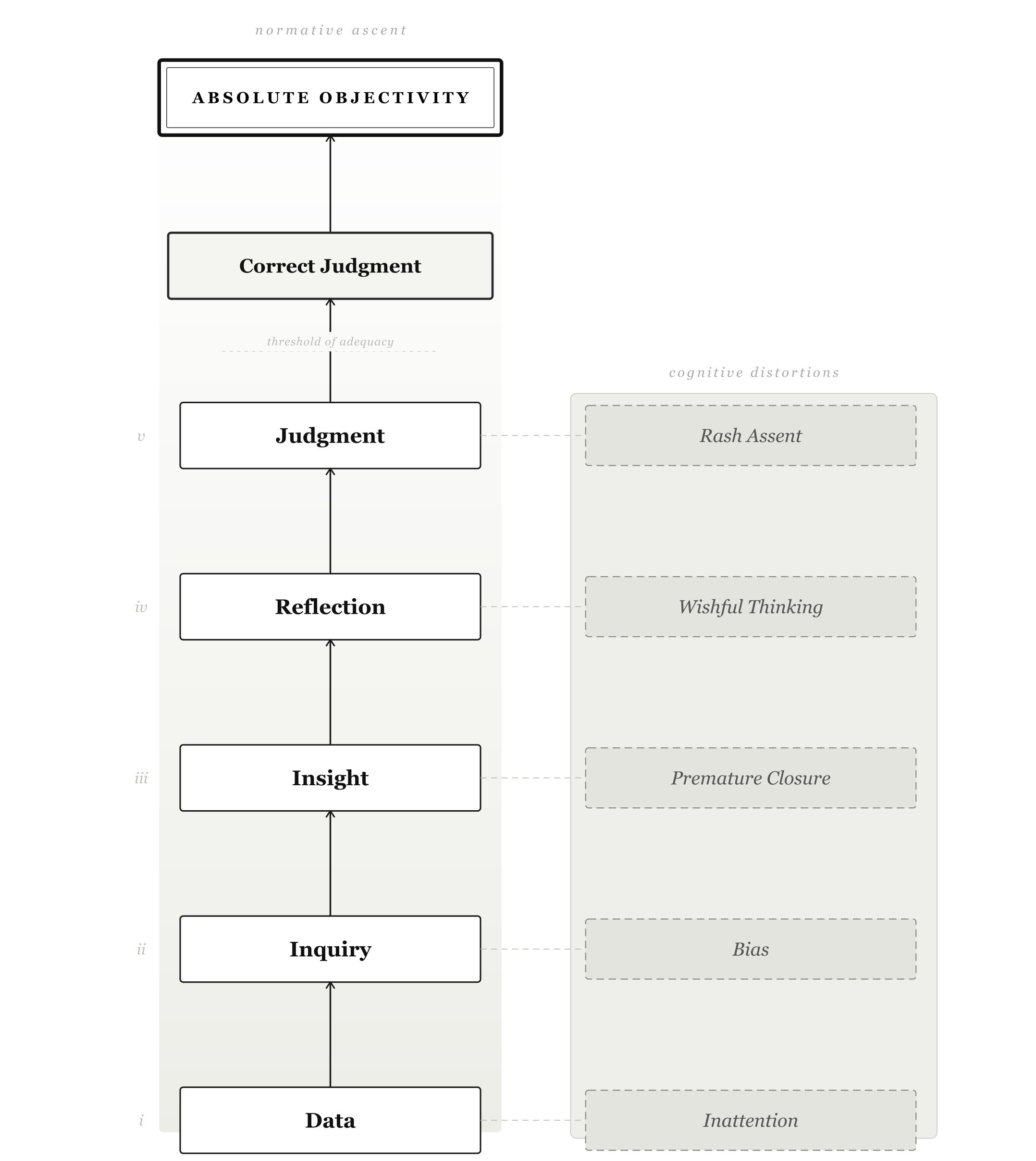
Before judgment, one may imagine, consider, formulate, suppose. One may possess a dazzling hypothesis and turn it in the light like a jewel. Yet one still has not crossed the decisive threshold. Lonergan insists that human knowing moves through levels. There is the given. There is inquiry and insight. Then there is reflection and judgment. On that third level, there emerge truth and falsity, certitude and probability, and the personal responsibility that belongs to affirmation and denial.3
That last point matters more than it first appears. Judgment is not a decorative flourish appended to thought. It is the moment in which the question changes. The earlier question asks what something might mean. The later question asks whether it is so. The whole soul tightens when that happens. One now stands before the possibility of contact with being, and also before the possibility of failure.
A bad theory can remain elegant. A bad judgment cannot remain sovereign forever. It will be contradicted by evidence, undone by experience, corrected by further questions, or hollowed out by its own incompleteness. That is why Lonergan can write in Method in Theology that the criterion of correctness is whether one’s insights are ‘invulnerable,’ whether they ‘meet all relevant questions,’ and whether no further questions remain that could correct or qualify them.4 The phrasing is exact and almost military. A correct judgment can stand the siege.
An incorrect judgment therefore tells us something positive. It tells us that judgment lives under a discipline that it did not invent. We are free to affirm, yet the affirmation itself remains answerable. The mind is not a little sovereign state issuing decrees to the universe. It is more like a knight under vows. It may be brave or cowardly, honest or evasive, but it does not decide the terms of reality. It serves them.
This is why error plays such a decisive role. If judgment could not be wrong, it could never be right in a meaningful sense. Then there would be opinions, projections, constructions, perhaps even powerful constructions. There would be no truth worthy of the name.
From Thought to Judgment
Lonergan’s account turns on a distinction modern culture has nearly lost, the distinction between thinking and knowing.
We flatter ourselves too easily here. Because we can think something, we half suppose that we know it. Because we can repeat a position, we imagine that we have earned it. Because we feel the heat of conviction, we assume that reality has signed the paper. Lonergan cuts through that whole fog. Thinking is one thing. Knowing arrives only with judgment. The notion of being itself drives toward this point. We think for the sake of judging. We seek understanding so that we may answer the further question, is it so.5
That simple move is the pivot of the whole matter. A centaur can be thought. A scientific theory can be thought. A memory can be thought. A fantasy can be thought. Yet thought, by itself, leaves the matter suspended. Judgment decides. Judgment says yes, or no. Judgment affirms or denies. It bears responsibility.
Here the role of incorrect judgment becomes even clearer. One judges falsely because the conditions for reasonable affirmation have not in fact been met, though one has pretended or assumed that they have. A such, it cannot be said that one does not judge falsely because judgment is arbitrary. The mind has leaped before it had the right to land.
Lonergan indicated for us the ground of correct judgment calling it the virtually unconditioned. That sounds forbidding until one sees what it means. The mind asks, in effect, whether the relevant conditions have been fulfilled. When reflective understanding grasps that they have, judgment may rightly affirm. This is why he says that6 ":
the ground of absolute objectivity is the virtually unconditioned that is grasped by reflective understanding and posited in judgment.
That is the whole bridge in one compact sentence. Judgment becomes objective because reflection has reached a point where the conditioned claim now stands with its relevant conditions fulfilled and not through magic. The judgment, therefore, does not float free as a private mood but more precisely enters the order of being.
One immediately sees the negative implication. Incorrect judgment occurs wherever that reflective grasp is defective, hurried, distorted, or refused. The mistake may arise from haste. It may arise from vanity. It may arise from fear. It may arise from the refusal to ask one more question because that question might disturb the conclusion one desires. Lonergan names this moral and cognitional deformation with great sobriety. Normative objectivity stands against wishful thinking, against rash judgment, against excessive caution, and against the interference of love or hatred, joy or sadness, hope or fear, with the proper march of knowing.7
That is one of his most profound insights. Error is rarely a merely technical defect. It often has a moral atmosphere around it. There is something one wanted too much. There is something one feared to see. There is some question that one quietly declined to ask.
In that sense, incorrect judgment is spiritually diagnostic because it reveals whether the subject has submitted himself to the discipline of intelligence and reasonableness, or whether he has attempted to conscript intelligence into the service of appetite.
The Road Beyond Kant
Kant knew that knowing could not be understood by pretending the subject was absent. For that alone, he remains a giant. He saw that the mind contributes form. He saw that experience does not arrive as a bare metaphysical package with its explanatory labels already attached. But Lonergan thinks Kant finally imprisoned the subject inside an account of conditions without adequately attending to the living operations by which knowing unfolds.
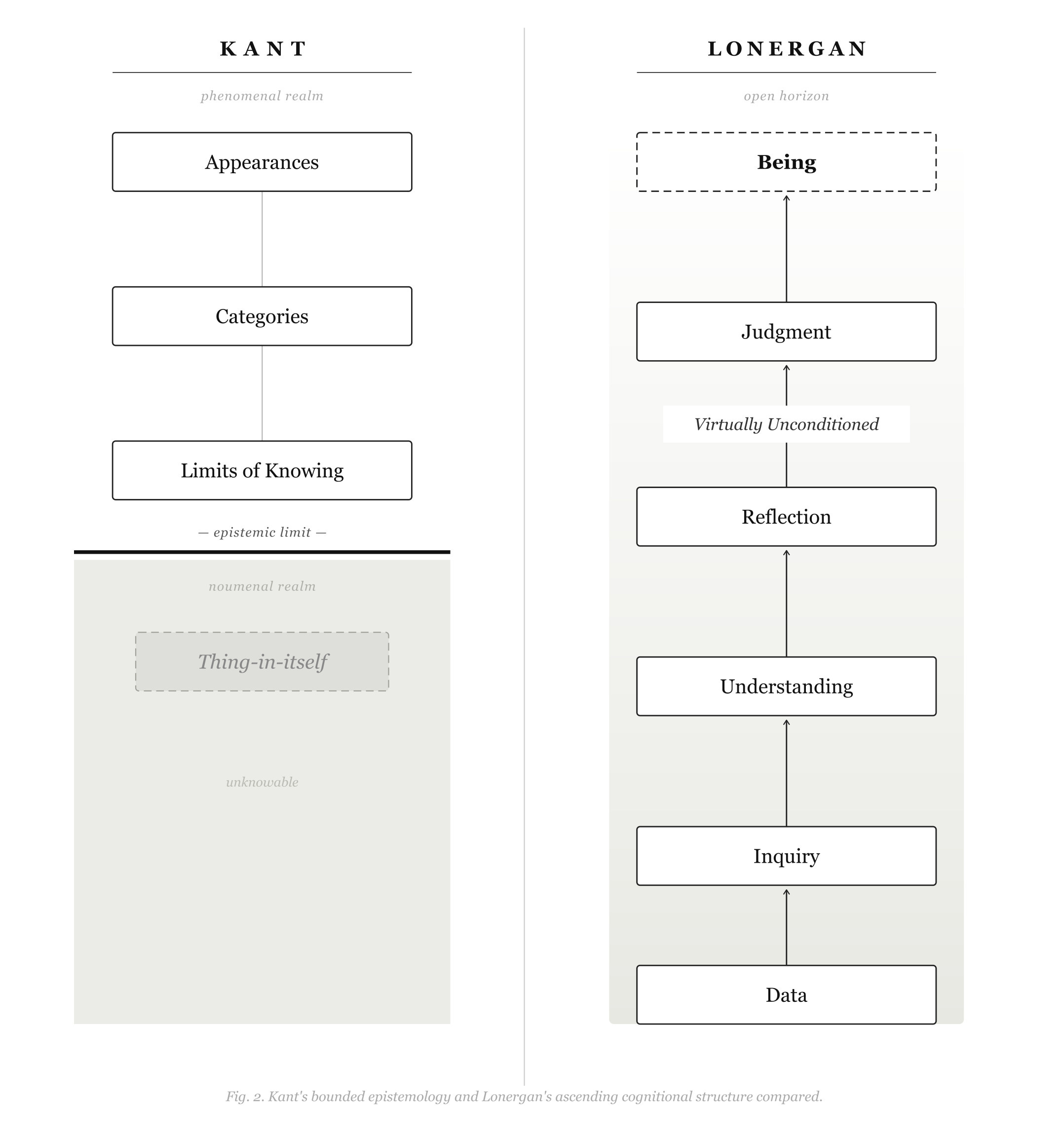
The difference becomes sharp in Lonergan’s contrast with Kant in the self-affirmation chapter of Insight. He writes that Kantian theory has no room for consciousness of the generative principles behind the categories. It can point to the categories in judgments, yet it cannot get behind them to their source. Lonergan’s response to this is unsurprisingly blunt. Inquiry and reflection do occur. Inquiry is generative of understanding. Reflection is generative of the reflective grasp of the unconditioned, and that grasp is generative of judgment.8
This is the point at which Lonergan steps beyond Kant. Kant asks for the conditions under which objects may be known as appearances. Lonergan asks for the conditions of a possible judgment of fact as an act. That shift is decisive and he says so directly. His concern is with “the possible occurrence of a judgment of fact,” with the conditions of “an absolute and rational yes or no.”9
The difference sounds technical. It is actually civilizational.
For if one begins with the conditions of appearance, one is forever tempted to speak as though the subject were trapped within a world merely for us. If one begins with the act of judging, one must follow the inner dynamism of inquiry toward that point where the mind intends being itself. Lonergan refuses the notion that transcendence means somehow climbing out of the subject as if the subject were a locked room. He says transcendence lies in heading for being, within which the distinction between subject and object is later found.10
This is why Kant cannot accommodate absolute objectivity in Lonergan’s sense. He can secure the formal structure of experience. He cannot fully account for the reflective act by which intelligence, under the pressure of evidence and the demand for sufficiency, reaches the virtually unconditioned and affirms. Lonergan even remarks that without judgments of fact one cannot get beyond mere analytic propositions.11 There is the whole dispute in miniature.
Kant, for all his greatness, leaves the mind too close to its own forms. Lonergan allows it to move through judgment into the absolute realm.
The Three Objectivities and the Ascent to the Absolute
Lonergan’s account of objectivity is often summarized by naming three moments, experiential, normative, and absolute. The summary is accurate, though one must immediately add that these are not three disconnected theories laid side by side like tools on a shelf. They are moments within one movement of knowing.
Experiential objectivity concerns the givenness of the data. In the world mediated by meaning, Lonergan says, there is an experiential objectivity constituted by the givenness of the data of sense and the data of consciousness.12 Something is there to be attended to. Something is given. That givenness is indispensable. Yet it does not judge itself.
Normative objectivity concerns the immanent demands of inquiry and reflection. It is constituted by the exigences of intelligence and reasonableness.13 One must ask the relevant questions. One must submit the insight to scrutiny. One must refuse the counterfeit satisfactions of premature closure. One must let the matter be difficult if it is difficult. This is the sphere in which the subject either becomes authentic or begins to decay. Here, the possibility of error is ever-present because the subject may cheat. He may become lazy, ideological, sentimental, resentful, or merely bored. He may want the world to be simpler than it is.
Absolute objectivity arrives when the movement has gone through both prior moments and reached affirmation. Lonergan describes it with extraordinary clarity by contending that, through experiential objectivity, the conditions are fulfilled. Through normative objectivity, the conditions are linked to what they condition. Their combination yields a conditioned with its conditions fulfilled, and that in knowledge is a fact, while in reality it is a contingent being or event.14
That is the whole architecture. The mind attends. The mind inquires. The mind reflects. Then the mind judges. At that point, if the judgment is correct, it possesses absolute objectivity.
The word absolute frightens modern people because they assume it must mean something swollen, totalizing, tyrannical, or psychologically infallible. Lonergan means none of these things. He means that the content of the true judgment is withdrawn from relativity to the subject who utters it, and to the place and time of utterance. He gives the famous example of Caesar crossing the Rubicon. The event was contingent and historical. Yet if it is true that Caesar crossed, then no one anywhere may truly deny it. The truth is public because the judgment has absolute objectivity.15
That publicity matters. It means truth is shareable. It means the true judgment belongs to more than the psychology of its first speaker. It means the mind, when it judges correctly, has entered a realm in which what is affirmed stands independently of the fluctuating moods and locations of the one who affirmed it.
Now the role of incorrect judgment returns with even greater force. If absolute objectivity exists, then error is no small thing. It is not merely a stylistic blemish or a local inconvenience. It is a failure to reach what one was made to reach. It is a wound in the very vocation of intelligence.
Authentic Subjectivity and the Hard Road to the Real
Modern people often imagine that subjectivity and objectivity stand as enemies facing one another across a battlefield. The more subjective one is, the less objective one becomes. Lonergan reverses the matter. He says in Method in Theology16 that
objectivity is simply the consequence of authentic subjectivity
That sentence should be read slowly because it sounds like a paradox and turns out to be a definition.
The subject does not reach objectivity by disappearing but by becoming attentive enough, intelligent enough, reasonable enough, honest enough, to let the real have its due. Subjectivity becomes authentic through submission to its own proper norms. Then judgment becomes trustworthy. Then objectivity appears as the fruit of inward discipline.
This is also why incorrect judgment has such seriousness. False judgment is often the symptom of inauthentic subjectivity. Some deformation has entered. Perhaps the man loves being right more than he loves reality. Perhaps he is driven by resentment. Perhaps he wants the prestige of certainty without the labor of questioning. Perhaps he has made an idol of his own formulations. Then the mind closes around itself like a fist.
Peterson, at his best, sees something similar in psychological language. He describes the demonic spirit as the desire to be right once and for all, the desire that falls in love with its own productions and can no longer see beyond them.17 That formulation is not Lonergan’s, but it puts a finger on a spiritual danger Lonergan knew well. A man may refuse further questions because further questions threaten his position. At that moment, intelligence is defending a little kingdom rather than serving truth.
Lonergan’s remedy is both severe and liberating at once, as is often necessary. Keep asking what has not yet been understood. Keep adverting to the questions that remain. Refuse the counterfeit rest that comes too early. In interpretation, he says that one reaches judgment when no further relevant questions arise, and even then, one speaks modestly because further relevant questions may have been overlooked.18 That is disciplined humility, a humility required of beings who can really know and can also really fail.
There is something morally bracing in this. A culture that has forgotten judgment oscillates between dogmatism and fatigue. One faction shouts certainties. Another faction, disgusted by the shouting, abandons truth itself and retreats into procedure, preference, or irony and apathy. Lonergan offers a sterner hope. The mind can attain the real. It does so through a long obedience inside the operations of consciousness. It can fail through corruption, laziness, bias, and fear. That is precisely why correctness matters.
The Seriousness of Saying Yes
The deepest issue, therefore, is not whether we ever feel certain. A fanatic may feel certain. A fool may feel certain. A frightened man may cling to certainty as a drowning man clings to driftwood. Lonergan is asking a much harder question. When is a ‘yes’ warranted? When may judgment rightly cross the line from consideration to affirmation?
His answer places the human person under a high calling. Attend. Inquire. Understand. Reflect. Judge only when the conditions have been met. Ask again if they have not. Permit reality to correct you. Accept the wound if you were wrong because that wound is medicinal. It reminds the mind that it was made for being, not for the comfortable worship of its own images.
Error then becomes something almost noble, if one receives it rightly. It is the crack through which the light enters. It is the humiliation by which false sovereignty is broken and the reminder that judgment has gravity because truth is real.
Lonergan differs from Kant here because he trusts the mind’s interior dynamism more radically. In an ironic sense, he is more Kantian than Kant himself. He thinks inquiry and reflection are not ornamental additions to an already closed structure. They are generative. They lead to judgment. Judgment reaches being. In that reaching, objectivity becomes absolute.
That claim is hard. It is also sane. For without it, one is left with thought circling thought, language talking to language, and consciousness hovering over its own productions like a king over an empty court. With it, one may finally say what common sense has always half known and what modern philosophy has often feared to confess. A correct judgment really does put us in touch with what is so.
And that is why incorrect judgment matters so much. It is the shadow cast by the dignity of judgment. Only a creature ordered toward truth can fail in this way. Only a mind made to affirm being can miss it, then ache for it, then be corrected by it, then return again to the task.
The alternative is far worse than error. The alternative is a world in which there is no real correction because there is no real truth to be corrected toward. Lonergan will not accept that. He thinks the mind is under judgment because the real is there. He thinks objectivity is possible because authentic subjectivity can become answerable to the real. He thinks a true yes is possible.
He is right.
Bernard Lonergan, Insight (CWL 3), 366.
Ibid., 364.
Ibid., 299.
Bernard Lonergan, Method in Theology (CWL 14), 154.
Lonergan, Insight, 378.
Ibid., 402.
Ibid., 405.
Ibid., 365.
Ibid., 363.
Ibid., 401-402.
Ibid., 366.
Lonergan, Method in Theology, 247.
Ibid., 247-248.
Ibid.
Lonergan, Insight, 402.
Lonergan, Method in Theology, 248.
Jordan B. Peterson, 12 Rules for Life, 210.
Lonergan, Method in Theology, 154-158.