

Why Judgment Collapses Before Civilization Does
On Bias, Moral Shortcuts, and the Flight from Responsibility

Why the Longer Cycle Begins in the Mind
Civilizations rarely die because they run out of information. They die because they lose the interior operations that convert information into knowledge, knowledge into judgment, and, more practically, judgment into policy and culture. Similarly, as the buildup is cognitional before it is political, so is the breakdown cognitional before it is political. The visible disasters arrive late.
Lonergan’s analysis names the sequence with what I think we can safely say is an uncomfortable clarity, that is, progress is cumulative when intelligence does its proper work; decline is cumulative when intelligence refuses its proper work. In Insight, he states that the longer cycle
“is to be met, not by any idea or set of ideas on the level of technology, economics, or politics, but only by the attainment of a higher viewpoint in man’s understanding and making of man.”1
The disease is not “out there.” It is a degraded pattern of knowing that becomes normal, then institutional, then compulsory.
This means that the crucial point is structural. Judgment collapses first. Civilization continues on inherited momentum, on procedures, budgets, credentialing, legacy infrastructure, all the while the mind that once governed it hollows out. Institutions become shells that still function but increasingly exist in isolation from reality.
Thought Is Not Knowledge
Lonergan’s distinction is decisive, yet it remains commonly ignored. Experience plus understanding yield thought; they do not yet yield knowledge. To move from thinking to knowing, the subject must perform a further act, the act of reflective understanding, culminating in judgment. In Method in Theology, he insists that without this third level, “a reflective grasp of the virtually unconditioned and its rational consequent, judgment,” one remains trapped in unstable alternations between empiricism and idealism, between “what I see” and “what I feel,” neither of which is knowledge.2
Modern culture trains the opposite habit. It trains endless interpretation with minimal verification. It multiplies “takes” and “narratives,” then treats selection among them as a matter of temperament or tribe. The result is not the pluralism one would expect. Instead, the result is the destruction of the very norms by which plural claims can be adjudicated.
Essentially, once judgment weakens, everything downstream degrades:

This is how meaning becomes a weapon rather than a means of mediation.
The Flight From Understanding Is Not a Personal Quirk
Lonergan refuses the comforting idea that irrationality is a fringe problem. In the preface to Insight, he describes “the flight from understanding” as a systematic pattern when he says that it “blocks the occurrence of the insights that would upset its comfortable equilibrium,” and it is “resourceful and inventive, effective and extraordinarily plausible.”3
When this flight takes on a cultural scale, it produces the signature feature of decline, which is a society that cannot bear the disciplines of reflective correction. Lonergan makes the practical consequence explicit when he says that blocked insights yield unintelligent policies; deteriorating situations then appear to “verify” the bias that caused the deterioration; intelligence is finally judged irrelevant to practical living; and “initiative becomes the privilege of violence.”4
That is the core mechanism. It is why judgment collapses before civilization does, because civilization can coast on routines, yet it cannot coast on reality-contact.
When Common Sense Absolutizes Itself, It Produces Disaster
The longer cycle is driven by what Lonergan calls general bias, that is, common sense mistaking its horizon for the whole of reality, and dismissing theoretical intelligence as useless or pretentious.
It is not the healthy common sense that navigates concrete life, but the heuristics we use to get by. It is common sense that becomes hostile to reflective questions, impatient with evidence, allergic to long-range consequences, and addicted to “the easy, obvious, practical compromise.”5
This is why modern political discourse is saturated with slogans that function as substitutes for judgment. The slogan feels like decisiveness. But it is not. It is actually the refusal of the reflective act that would determine whether the slogan corresponds to reality. This is what Peterson rightly deems as the “low-resolution” way of looking at the world.6
When judgment collapses, politics becomes myth-management. And I do not mean myth in the noble sense of symbol carrying meaning, but myth as an instrument, those simplified narratives deployed to organize resentment, consolidate identity, and, consequently, avoid the labor of verification. Lonergan describes the cultural result with grim economy when he says that theory can fuse “more with common nonsense than with common sense,” making nonsense “pretentious and, because it is common, dangerous and even disastrous.”7
What he offers is a technical diagnosis that the public mind loses discriminating judgment and gains rhetorical certainty. I am sure that some examples come to mind…
Meaning Without Judgment Produces the Cultural Slum
A society can remain highly literate and still become cognitively impoverished. So much for the Soviet wager that universal literacy would manufacture the New Man. Lonergan describes how cultural discontinuity yields degeneration, that is, traditions become “beyond their means,” they “cannot maintain it,” and lacking the capacity to transform and integrate, “the meaning and values of human living are impoverished […] The culture has become a slum.”8
This is what it looks like when the “world mediated by meaning” remains true in fact, but false in operation. Mediation becomes noise rather than intelligibility.9 Meanings proliferate, values flatten, the will narrows. People still speak constantly, but speech no longer functions as a vehicle of truth. It functions as a tool for social positioning.
The decisive loss is not “faith” or “trust” as emotions. The decisive loss is interiority, the subject’s capacity to identify what he is doing when he knows, the noticing, the questioning, the understanding, the verifying, the assenting, the deciding. Authenticity is fidelity to the norms implicit in consciousness, and decline is cumulative violation of those norms.
Peterson’s Contribution and the Missing Step
Peterson’s cultural impact is real. He reintroduced moral seriousness, truth-telling, responsibility, and the demand that one’s life not be structured by self-deception. He also sees ideological possession as a pathology of modern consciousness. However, Peterson’s framework often functions as a catalyst that awakens attention and concern, but it does not always force the decisive Lonerganian question at the rational level, i.e., whether the meaning that moves the psyche is true.
The psyche cannot simply be trusted to generate value (it cannot), and I know Peterson would agree, given his repeated and justified critiques of Nietzsche.10 The psyche can fragment, become tyrannical, or become possessed unless ordered to something superordinate. That is exactly where judgment matters. Meaning that motivates without judgment that verifies becomes either sentimentalism or fanaticism.
Lonergan’s insistence is harsher and even more useful. He holds that progress proceeds from subjects “being their true selves by observing the transcendental precepts, Be attentive, Be intelligent, Be reasonable, Be responsible.”11
They may seem like prima facie moral decorations. They are not. Instead, what he offers are the operating conditions for contact with reality. When they are bypassed, authenticity is replaced by performance, and civilization inherits the results.
6. The Operational Signs of Judgment Collapse
Judgment collapse has stable symptoms, independent of ideology:
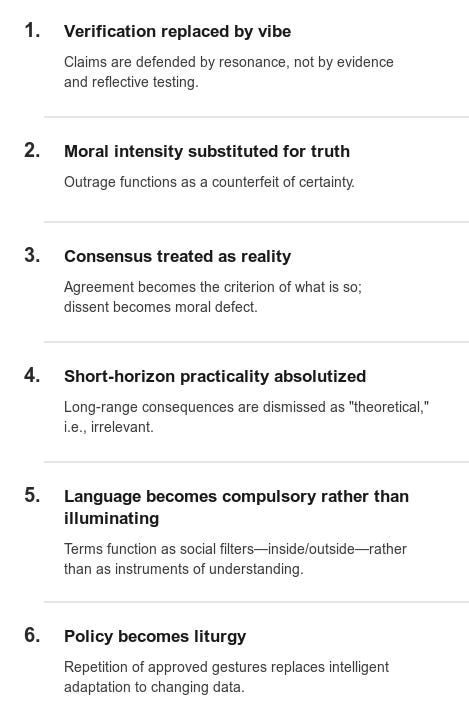
Do not confuse these with merely cultural annoyances. They are the inner mechanisms of the longer cycle, i.e., blocked insights, degraded judgment, deteriorating situations, and then the self-validating illusion that intelligence is impractical.
The Only Remedy at the Level of the Disease
Lonergan’s claim is not that better ideas fix decline. He explicitly denies that the longer cycle is met by programs at the level of “technology, economics, or politics.”12 The remedy must match the disease; in this case, the recovery of judgment as a lived operation, and not as a classroom term.
That recovery is not a return to “rationalism.” Rationalism is often just another cognitional myth. Lonergan’s target is the concrete act of reflective understanding that asks whether conditions are fulfilled, whether evidence is sufficient, whether the conclusion is warranted.13
This is why the deeper crisis is always a crisis of authenticity, the subject’s failure to be governed by attentiveness, intelligence, reasonableness, and responsibility.14
When enough subjects fail in that way, institutions cannot compensate. They can only delay the consequences.
Civilization does not first lose elections, economies, or wars. It first loses the habit of judging truly. Then everything else follows.
Bernard J. F. Lonergan, Insight: A Study of Human Understanding, Collected Works of Bernard Lonergan, vol. 3 (Toronto: University of Toronto Press, 1992 [orig. 1957]), 258.
Bernard J. F. Lonergan, Method in Theology, Collected Works of Bernard Lonergan, vol. 14 (Toronto: University of Toronto Press, 2017), 201.
Lonergan, Insight, 6.
Lonergan, Insight, 8.
Lonergan, Insight, 8.
See at 30:30-41:29:
Lonergan, Method in Theology, 94.
Lonergan, Method in Theology, 95.
Lonergan, Method in Theology, 108.
See James J. Gibson, The Ecological Approach to Visual Perception, https://library.uniq.edu.iq/storage/books/file/The%20Ecological%20Approach%20to%20Visual%20Perception%20Approach/1667383098The%20Ecological%20Approach%20to%20Visual%20Perception%20Classic%20Edition%20(James%20J.%20Gibson)%20(z-lib.org)%20(1).pdf
Lonergan, Method in Theology, 52.
Lonergan, Insight, 232.
See Lonergan, Method in Theology, 298.
Lonergan, Method in Theology, 116-117.
Both Progressivism and Movement Conservatism rely on this degenerative process to operate.