

The School Before the State
Why Judgment Must Be Formed Before It Can Be Governed

Arc III: The Carriers Of Meaning, 1/6
A state can regulate conduct. It cannot create judgment by decree. That work begins earlier.
By the time a ministry or a bureaucracy tries to stabilize public life, the decisive labor has already succeeded or failed elsewhere. It has succeeded or failed in the places where the young were taught how to see, how to ask, how to weigh, how to judge, how to answer, how to decide. A regime inherits its people long after a civilization has been schooling them. That is why the school comes before the state.
I do not mean the school only as a building or a labor market vestibule. I mean the school in the thicker sense, as the place where the young are initiated into reality through language, memory, evidence, inheritance, and responsibility. If that initiation fails, public life does not become freer, as the misguided utopians are wont to dream. It becomes thinner, and, consequently, louder and easier to manage.
I. The State Arrives Late
Modern politics habitually mistakes its own position in the order of causes. It sees disorder in the adult world and assumes that more regulation, sharper procedure, or better metrics will repair the break. Sometimes such measures are necessary. None reaches the root.
A polity reasons together only if it has first learned how.
That learning begins in formation, not in parliament. Long before a citizen debates policy, he has already been taught what counts as evidence, what sort of questions are welcome, what authorities may be trusted, what kind of speech deserves respect, and whether truth is something to be pursued or something to be managed. He has already been taught, in other words, how judgment works, or how to live without it.
This is why educational decline precedes political managerialism. When judgment weakens, procedure thickens. When discrimination fails, supervision expands. A state that must constantly compensate for malformed attention is governing on borrowed time.
II. Training And Education
Training matters. A society without skill decays quickly.
Education is another thing.
Training produces function. It teaches a person how to perform within a frame already given. Education forms the person who can understand the frame, judge its adequacy, and act responsibly within or against it. Training can make a man efficient. Education must make him answerable.
The distinction is decisive because modern systems love the first and increasingly neglect the second. Training can be measured, standardized, certified, and sold. Education resists that treatment. It asks whether the student is becoming capable of reality contact. It asks whether he can attend without distraction, inquire without panic, speak without cant, and judge without hiding behind a borrowed script.
That is harder to quantify. So it is often displaced.
Peterson sees one side of this clearly. “You cannot hit a target that you refuse to see.”1 That is psychological. It is also pedagogical. The student is always being taught what to see. He is always being aimed. The only question is whether that aim is truthful.
A school that teaches only performance creates capable operators who can still be governed by fashion, fear, or prestige. It produces dexterity without depth. Such persons can keep systems running. They cannot tell when those systems have gone mad.
Competence without judgment produces clever barbarians.
III. No Neutral Pedagogy
Every school carries a moral grammar.
Some confess it. Others conceal it beneath the language of openness, outcomes, safety, or inclusion. Concealment does not abolish it. It only makes the regime less intelligent about itself.
Lonergan’s anthropology makes the point in one stroke. Education takes us out of “the infant’s world of immediacy” and places us in “the adult’s world,” which is “a world mediated by meaning.”2 That sentence is enough to ruin the neutrality fantasy. If adulthood itself is mediated by meaning, then the school is one of the places where those mediations are first made durable.
The curriculum already ranks goods. The discipline already presupposes an account of authority. The language of the classroom already selects what can come to the fore. Lonergan says it with calm finality, saying that “The available language, then, takes the lead.”3 The child does not first form a complete private world and then decorate it with public terms. He is led into a world already articulated by others.
So the school always catechizes, even when it denies the word.
It teaches whether truth is real or merely strategic. It teaches whether memory is gratitude or embarrassment. It teaches whether speech is the vehicle of judgment or the badge of belonging. It teaches whether difficulty is a summons to growth or a trauma to be administratively preempted. And because “all such change involves change of meaning.”4 educational reform is never merely technical. It is always civilizational.5
This is why the phrase “neutral pedagogy” names nothing stable. A school can be fair. It can be restrained. It can refuse sectarian capture. Those are real goods. Yet it cannot avoid forming souls. The only issue is whether that formation is ordered toward truth and responsibility, or toward suspicion and compliance.
IV. When Judgment Fails, Management Expands
A school that stops forming judgment does not leave the student untouched. It hands him over to weaker teachers.
The feed will teach him. The crowd will teach him. The reputation market will teach him. Procedure will teach him. Bureaucratic fear will teach him. So will the soft coercions that flourish when people no longer know how to reason together.
This is the institutional consequence of pedagogical failure.
In my previous articles, I have attempted to create a thematic arc in order to show the pattern. Once judgment becomes suspect, procedure replaces deliberation. Metrics replace meaning. Enforcement intensifies. Legitimacy erodes. Then speech itself becomes the easiest surface on which conformity can be policed. That is not an accidental sequence but precisely what follows when a society loses confidence in judgment and substitutes management for persuasion. The school is one of the first places where that substitution is either resisted or normalized.
Lonergan again provides the deeper grammar. Human beings do not simply receive meanings. They grow “in experience, understanding, judgment” within available common meanings, and this process is called education from the schoolmaster’s side.6 That means educational failure is not a narrow institutional malfunction. It is a deformation in the very growth of persons.
The result appears later, but the seedbed is early. Here is a schematic way of looking at it:
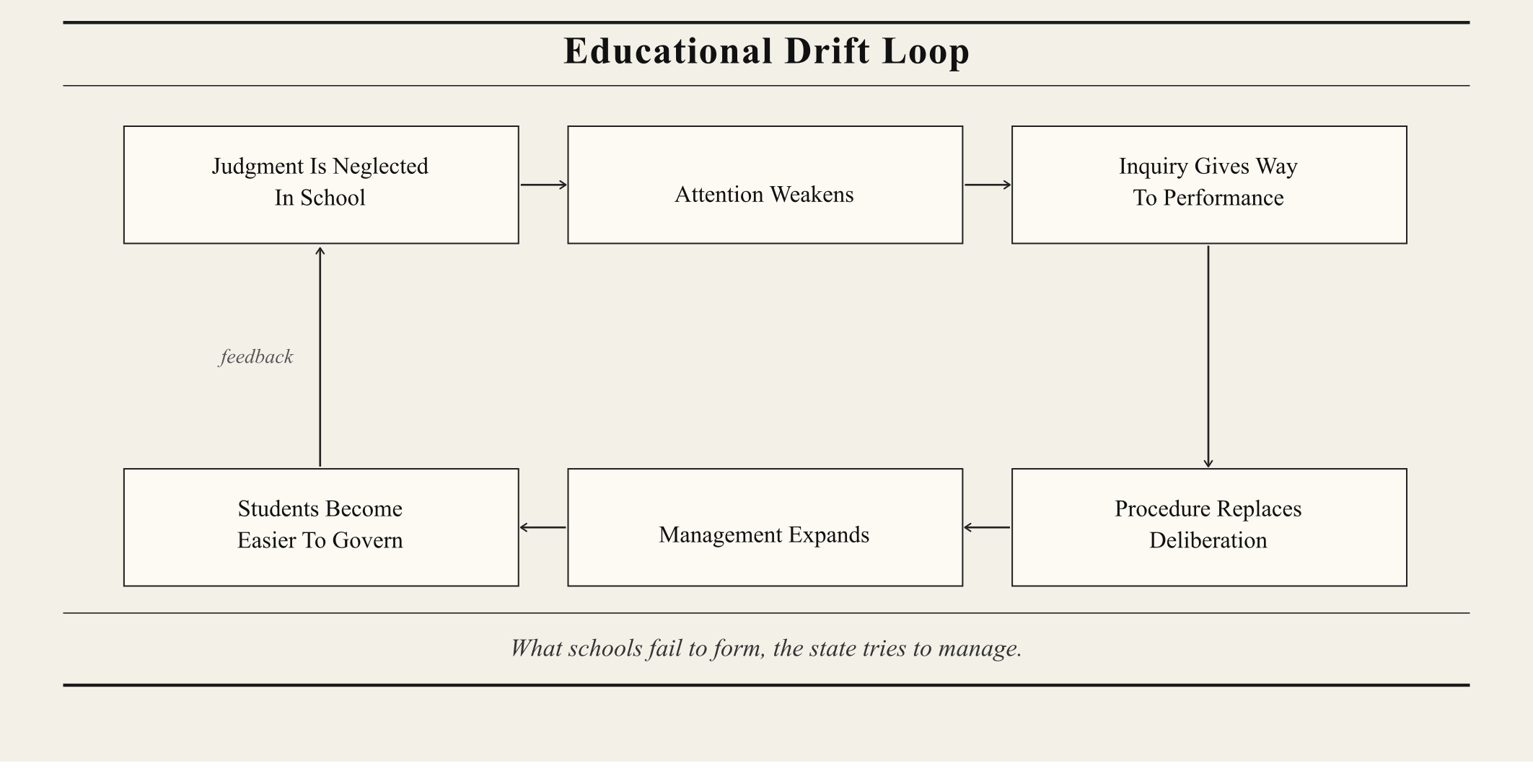
A generation taught to distrust substance and hide inside method will eventually ask institutions to do the same. Students trained to perform moral vocabulary without appropriation will become adults who speak in formulas and think in permissions. Then public life fills with persons who can signal, sort, and comply, while remaining unable to deliberate together about what is actually good.
By the time the state notices, the deeper loss has already occurred...
And then the compensation begins.
V. Peterson, Lonergan, And the Work of Formation
Peterson’s importance here should be granted fully. He has spent years addressing readers who were starved of demanding speech. He tells them to aim, to order, to articulate, to shoulder weight. That matters. He understands that education in the deeper sense is bound up with character, attention, and disciplined speech.
He also understands something many educators have forgotten. The young do not need flatter reassurance. They need initiation into seriousness. They need adults who can help them cross from vague intuition into responsible speech. Peterson calls that “a reasonable and valuable function for a public intellectual.”7 It is also a reasonable and valuable function for a teacher.
His strength, however, is strongest at the level of the subject. Lonergan lets us widen the frame. Judgment is not merely an individual skill but a socially mediated achievement. It depends on language, tradition, symbol, and institution. A school is, therefore, not only a place where one acquires discipline. It is one of the chief places where a civilization teaches the operations by which truth may later be pursued in common.
This matters because one can produce disciplined performers without producing judged intelligence. One can produce competent specialists who remain morally shallow. One can produce articulate cynics. One can produce high functioning souls with no deep interior norm beyond advancement.
That educational model is already politically fateful.
Peterson can remind a person to stand up straight. Lonergan explains how a world is built in which standing upright still means something.
VI. Reform Before Governance
Educational reform is upstream of political reform.
That may sound obvious, then radical, then obvious again.
A people that wants fewer compelled words, less administrative oversight, and more intelligent public life must begin where those capacities are first formed. It must recover schools that teach students to read patiently, to name carefully, to remember gratefully, to test claims, and to answer for what they say. Those are not ornamental accomplishments. They are pre-political conditions for self-government.
A school worthy of the name therefore does five things.
It trains attention rather than scattering it.
It teaches inquiry rather than ritual suspicion.
It forms speech for truth rather than for sorting.
It hands on memory rather than fashionable contempt.
It prepares the young for responsibility rather than permanent supervision.
Where those tasks are abandoned, the state inherits a deficit it cannot truly repair. It can regulate outcomes. It can certify performance. It can distribute incentives. It can punish deviation. It cannot, by those means alone, produce judgment. That work belongs earlier, in the patient labor by which the mind is taught to love what is real.
The school comes before the state for a simple reason. Judgment comes before governance. A civilization that forgets that order will try to administer what it no longer knows how to teach.
And that is how management begins to reign where formation has failed.
Jordan B. Peterson, Beyond Order, 103.
Bernard Lonergan, Method in Theology (CWL 3), 74.
Lonergan, Method in Theology, 68.
Ibid., 76.
Ibid., 74.
Ibid., 77.
Peterson, Beyond Order, 159.
An excellent article